01
Primary agricultural use is the threshold criterion
Under most international standards and accepted practice, an agrivoltaic project must demonstrate that agriculture remains the primary land use and provide credible evidence.
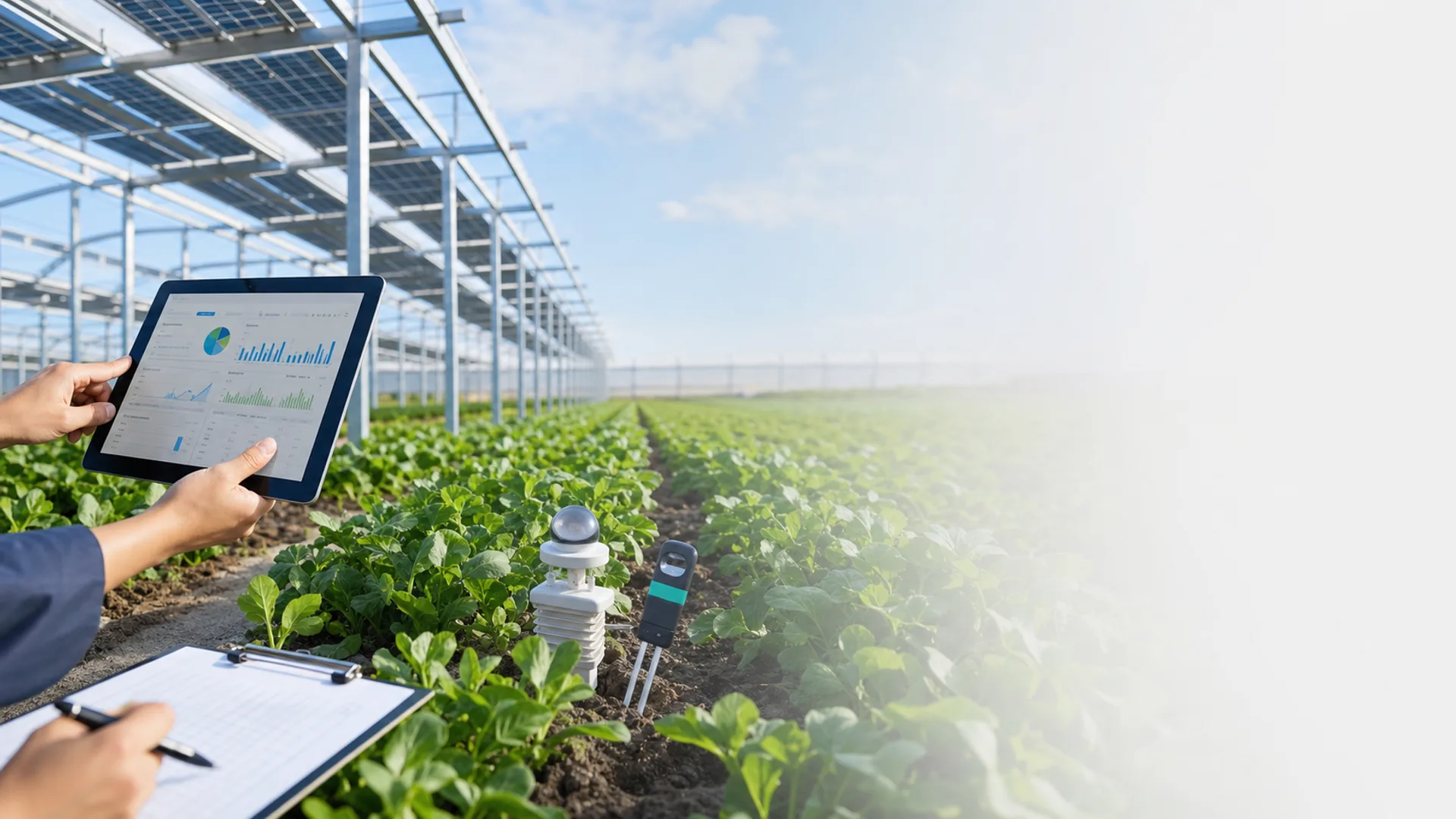
Work Areas
Verify the authenticity, compliance, and sustainability of "power generation + agriculture", benchmarking with international standards and local regulations.
Overview
The scope of Agri-PV projects covers planting, forestry, animal husbandry, fisheries, and sideline industries. Agri-PV is one of the fastest-growing land-use innovations in the global energy transition, but its dual-use nature also makes it highly contested. Ambiguous definitions, weak agricultural-output monitoring, and grey-zone land conversion are driving tighter oversight. Independent, science-based certification is therefore increasingly important for credible market access, green finance, and policy support. IAA acts as a neutral third-party certification and assessment body, drawing on relevant international standards while aligning projects with Chinese and host-country regulations.
Key knowledge
01
Under most international standards and accepted practice, an agrivoltaic project must demonstrate that agriculture remains the primary land use and provide credible evidence.
02
International practice distinguishes Category I (overhead / elevated) and Category II (interspaced / ground-level), each with distinct clearance, light-transmission, and machinery-compatibility requirements.
03
PAR distribution, dynamic shading, and microclimate effects must be modelled crop-by-crop; shade tolerance varies widely between leafy greens, tea, berries, and cereals.
04
Projects must meet applicable photovoltaic-array design standards and local wind and snow load codes, with additional requirements for elevated support structures.
05
Certification examines soil compaction, drainage alteration, pesticide and runoff pathways, and effects on pollinators, with reference to European and other relevant international standards.
06
Projects in China must comply with the regulations of the Ministry of Natural Resources on farmland protection, the 2023 PV land use standards, and the requirements of the National Energy Administration for centralized power station filing management in 2025.
Our solutions
Full-scope certification covering land-use eligibility, agronomic design, structural and electrical compliance, and operational monitoring — multi-year certificate with annual surveillance.
Staged technical and regulatory due-diligence for developers, investors, and lenders — benchmarking projects against international standards before fund delivery.
On-site sampling, remote-sensing analysis, and statistical comparison against control plots to confirm crop or livestock output meets certification thresholds through the lifecycle.
Provide an independent verification report, benchmarking with international (e.g. EU) and host country standards, assisting Agri-PV assets in obtaining ESG financing.
Technical arbitration and re-certification for projects facing regulatory enforcement, grid-connection disputes, or post-construction non-conformity findings.