Rural New Energy Planning

Work Areas

Rural New Energy Planning

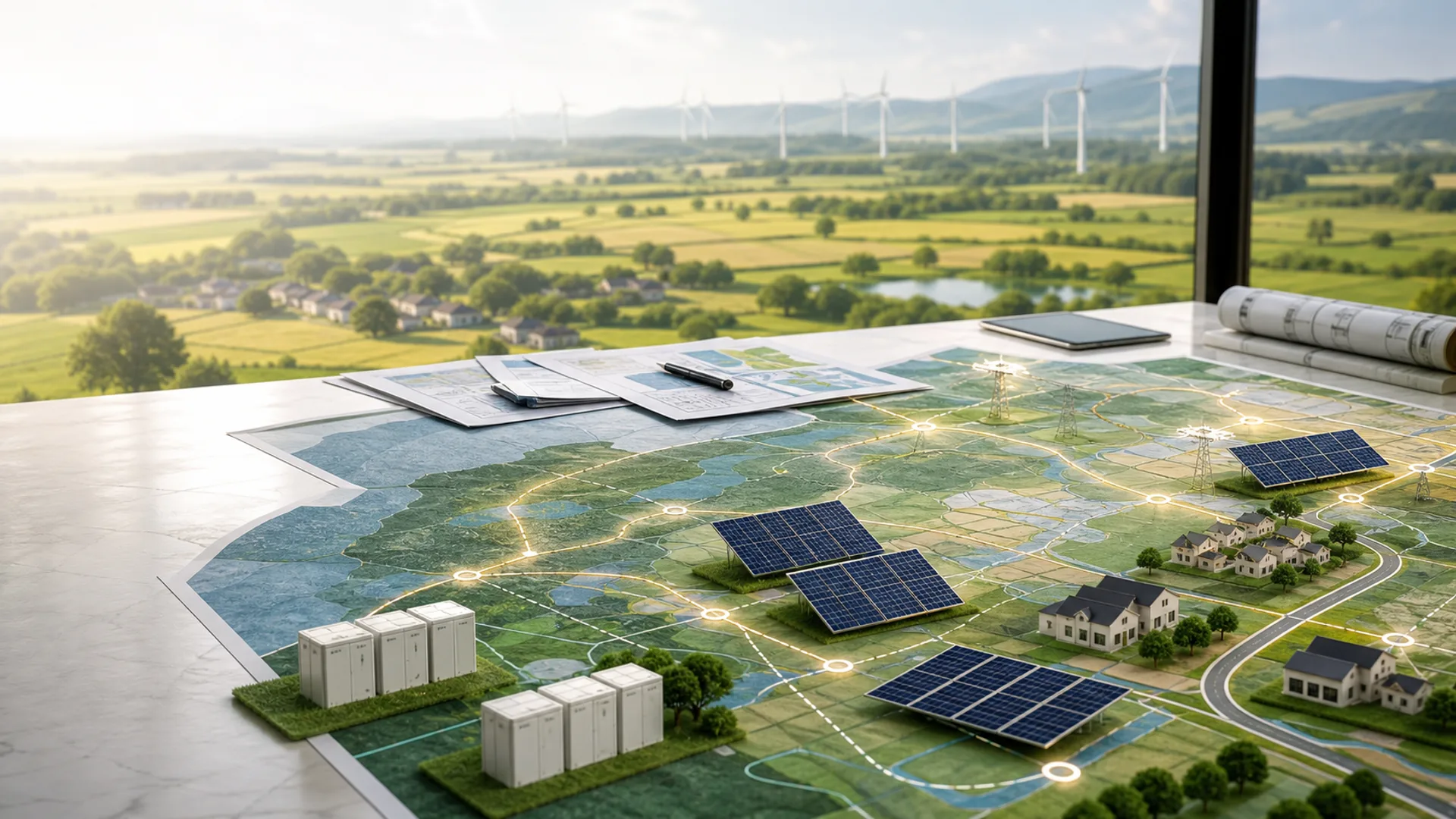
County-scale masterplans that weave PV, wind, biomass, storage, and agricultural demand into bankable, implementable roadmaps.

Overview

Rural areas hold a large share of the world's untapped renewable-energy potential, including distributed rooftop PV, decentralised wind, biomass and biogas, geothermal energy, hydropower, and flexible storage coordinated with agricultural loads. Unlocking this potential requires integrated county-scale planning across land use, grid capacity, agricultural seasonality, household demand, and local benefit-sharing. Rural energy transition is an important pathway toward UN Sustainable Development Goal 7, carbon-neutrality targets, and the Global Initiative for Energy Access. IAA supports governments, county energy authorities, rural collectives, and developers in producing science-based, financeable, and socially inclusive rural new-energy plans.
Key knowledge

01

County is the working unit

Both IRENA's sub-national planning experience and China's "whole county promotion" practice confirm that county scale can support the power grid and supply chain, while also taking into account land and multi-party coordination.

02

Distributed PV is no longer "the only game"

With the 2024 Wind Action plan allowing ≤20 MW village-scale wind, county plans must optimise PV-wind-storage-biomass mixes rather than single-technology rollouts.

03

Hosting capacity is the binding constraint

Rural distribution networks were not designed for reverse flow; planning must include hosting-capacity studies, voltage management, and targeted reinforcement.

04

Land-use compliance comes first

After the 2023 land-use notice and 2025 reclassification, plans must front-load compliance with permanent basic farmland, ecological red lines, and forest-land rules.

05

Rural energy is also a livelihood programme

Village-enterprise cooperation, land-rights equity contributions, and shared-revenue mechanisms are now expected components of any credible plan.

06

Electrification of agricultural demand

Cold chains, irrigation, greenhouse climate control, electric farm machinery, and clean heating and cooling reshape local load profiles, improve bankability, and should be planned alongside generation.

Our solutions

County-Level Renewable Master Plan

End-to-end service producing a 5–10 year roadmap covering resource assessment, technology mix, grid integration, land-use mapping, and investment phasing.

Distributed PV + Wind Integration Study

Technical study harmonising rooftop PV, ground-mount PV, and village-scale wind under the Wind Action framework, including hosting-capacity and curtailment analysis.

Agriculture-Energy Co-Planning

Sector-specific planning that aligns generation siting with agricultural cycles, irrigation demand, cold-chain build-out, and rural electric mobility.

Village-Enterprise Cooperation Model Design

Structuring equity, land-rights contribution, revenue-sharing, and dispute resolution between developers, village collectives, and county governments.

Policy & Subsidy Interface Service

Hands-on support for Rural Energy Revolution Pilot County applications, green credit, carbon-market eligibility, and provincial subsidy windows.

Want a deeper conversation on this practice?